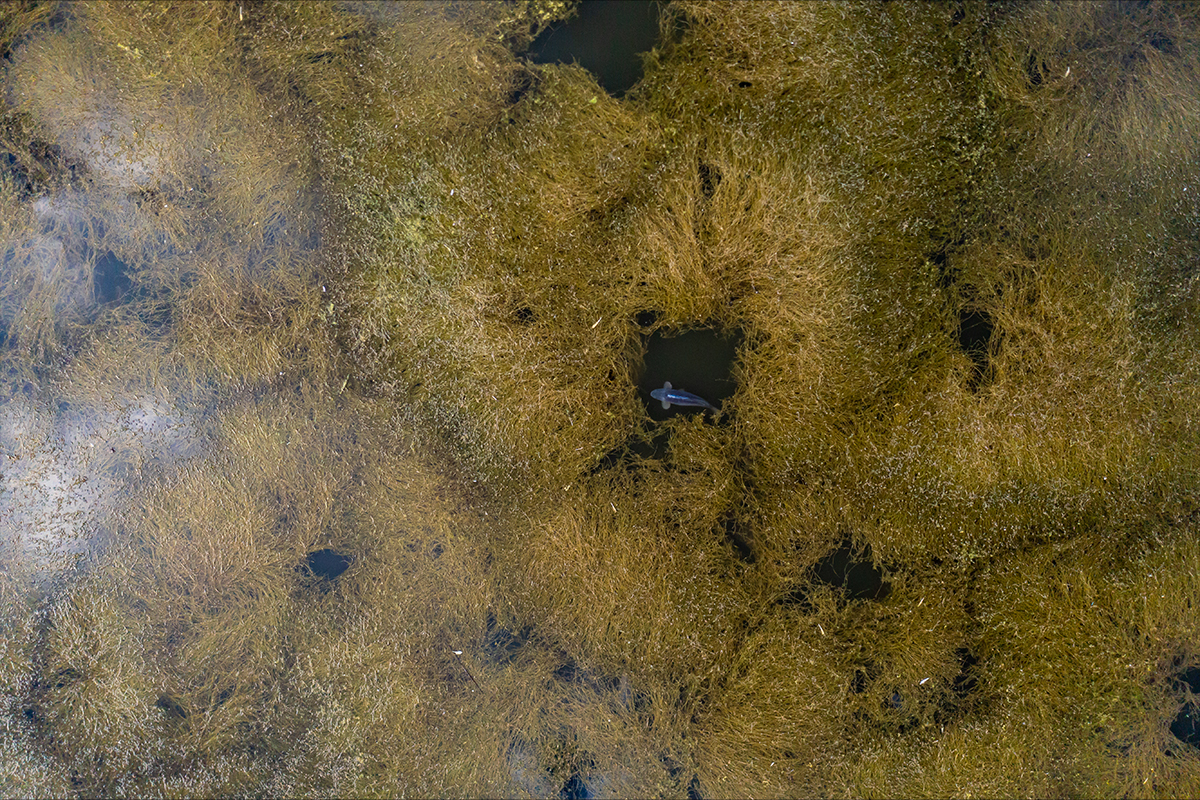
Carp Fishing Weedy Waters
Most of my carp angling over the past 30 years has been spent fishing various day-ticket and syndicate lakes within an hour of home. They’ve ranged considerably in size and depth, but many of them have been gravel pits and almost all have had one thing in common – weed.
Whether it’s Canadian pondweed, spiked water milfoil, Potamogeton or a thick covering of silkweed, I’ve spent a lot of time learning how to fish effectively in, around and on top of weed.
Weed can make carp fishing more challenging, but I certainly don’t see it as something to avoid. Carp love spending time around weed because it provides sanctuary and is full of natural food.
If anything, I’d much rather have my rig close to a weedbed – or even presented within the weed itself – than sitting in an area of completely barren open water.
The key is finding somewhere you can present a rig effectively and then using tackle strong enough to give yourself the best possible chance of landing anything you hook.
Here’s how I approach carp fishing in weedy waters.

Carp can often be found in and amongst Canadian pondweed
FINDING CLEAR SPOTS IN WEED
On gravel pits containing established weedbeds, one of the most important pieces of equipment I carry is a marker rod.
If I don’t have a dedicated marker set-up with me, I’ll at least use a rod and lead to investigate the swim.
I’m trying to understand what’s actually happening beneath the surface and, crucially, find areas within or between the weedbeds where I can present a rig effectively.
One thing I don’t necessarily look for is polished, clean gravel.
In fact, I often prefer to find an area of softer sediment or silt between the weed and gravel. If I’ve established that I can get a rig down and fishing properly there, I’m happy.
Once I’ve found the spot, I’ll clip up accurately so I can repeatedly hit the same area.
It’s worth spending time doing this properly. An extra 20 minutes with the marker rod can give me much more confidence for the rest of the session.

Time with a marker rod is usually time well spent on weedy waters
USE STRONG TACKLE FOR CARP FISHING IN WEED
Once I’ve decided to fish around weed, I want tackle that’s appropriate for the situation.
I’ll use a strong main line of at least 15lb breaking strain, and potentially considerably heavier. At the moment, I’m using PB Products Control in 24lb, although I’ve successfully used other main lines in the past.
The same thinking applies to my hooklink.
I’ll generally use a hooklink material of 25lb breaking strain or above, combined with either a size 6 or size 4 hook, depending on the particular pattern I’m using.
Personally, I wouldn’t use anything smaller than a size 6 in these situations.
Fishing close to substantial weedbeds isn’t somewhere I want to be undergunned.

Strong main line is essential on weedy waters
WHY I WANT TO LOSE THE LEAD IN HEAVY WEED
Another important part of my approach is using a lead arrangement that allows the lead to discharge when necessary.
If a carp charges into a weedbed with a lead still attached, there’s another piece of tackle hanging below the fish that can potentially become fouled in the weed.
Getting rid of that lead can make a big difference.
In many situations, once the lead has gone, the carp will rise higher in the water column. That can make it considerably easier to bring the fish over the top of the weed rather than having a lead dragging through it.
It’s a simple principle: once I’ve hooked the carp, landing it becomes the priority.
USING CHOD RIGS OVER WEED
One presentation I’ll happily use is a chod rig fished helicopter-style with a buoyant pop-up.
I’ll push the top bead well up the leader or tubing – perhaps two feet or more if the situation requires it – giving the hookbait the opportunity to settle over the weed.
For this type of fishing, I’ve used systems such as the Korda Heli-Safe, while there are also systems like the Fox Heli Clip that provide options over how the lead is set up.
The important thing for me is creating a presentation capable of coping with the weed I’m fishing over while giving me the option to lose the lead when required.

There are some great products currently available on the market that allow you to drop your lead
MY LEAD-CLIP RIG FOR WEEDY CARP WATERS
My second option is a fused lead-clip set-up.
I’ve found these work better for my fishing than traditional clips that use a peg to hold the swivel in position.
I don’t push the tail rubber on too tightly, because I want the system to eject the lead when required.
With a lead-clip arrangement, I’ll usually use a much longer hooklink than I might in other circumstances – typically somewhere between 10 and 18 inches.
I’ll then use either a pop-up or snowman presentation.
The idea is to give the rig enough flexibility to settle lightly over any weed rather than expecting it to land perfectly on a completely clean bottom.
HOW I FISH OVER SILKWEED
Silkweed presents a slightly different challenge.
A couple of the waters I fish don’t necessarily have defined weedbeds. Instead, much of the lakebed can be covered in silkweed.
Finding somewhere to present a rig becomes more difficult because there may not be an obvious clear spot.
In this situation, I’m not necessarily looking for somewhere completely free of weed. I’m trying to find an area containing less weed than its surroundings.
I’ll cast the marker rod around and pay close attention to the drop.
If the lead cracks down firmly, rather than giving me a dull thud or squelchy feeling, I’ll clip up and investigate that area more thoroughly.
I’ll cast repeatedly around the spot and have a good feel about.
One of my most useful tests is whether I can get the marker float to come up cleanly.
If it does, that’s a positive sign.
If I can’t get the float up, I’ll assume there’s enough weed down there to snag it and potentially make presenting a rig difficult. I’ll continue searching until I’ve found spots where the marker float comes up properly.
Once I’ve found three areas I’m confident in, I can get the fishing rods sorted.

Silkweed presents a slightly different challenge to most types of weed
MAP YOUR CARP-FISHING SPOTS
Something else I find incredibly useful is keeping a record of what I’ve found.
I’ll make a rough sketch of the swim, noting obvious far-bank markers, the areas I’ve discovered and the exact distances to them.
That means the next time I get into the swim, I’m not starting completely from scratch.
I’ll still check the spots because weed can change considerably. An area that was perfect during my previous session isn’t guaranteed to remain that way.
If it’s still suitable, happy days – I can get fishing.
If it isn’t, I’ll get the marker rod out and find somewhere else.

I always like to keep a record of the spots I find
THE BEST HOOKBAITS FOR FISHING IN WEED
My hookbait choice changes throughout the year.
Early in the season, I generally prefer something bright and highly attractive, with PBs and Milky Malts being two options I’ll regularly reach for.
As we move into June and beyond, I’ll generally start moving towards more match-the-hatch hookbaits.
There isn’t one hookbait that I use in every situation. I’ll consider the time of year, what I’m feeding and how I want the rig to sit before making that decision.
SOLID PVA BAGS FOR FISHING OVER SILKWEED
Another approach I like, particularly earlier in the year and on waters with plenty of silkweed, is solid PVA bag fishing.
Even then, I’ll usually try to place my solid bags in areas where the weed growth is lighter.
The big advantage is presentation.
Wherever that bag lands, I’m effectively putting down a small, neat parcel of food with the hookbait presented amongst it.
On waters where finding perfectly clean areas is difficult, that can be a very useful way of fishing.
DON’T BE AFRAID OF FISHING CLOSE TO WEED
This is probably one of the biggest things I’ve learned from spending so much time fishing weedy gravel pits.
Weed isn’t something I’m frightened of fishing near.
Carp love it.
It contains natural food and gives them somewhere they feel secure. If I find a substantial weedbed with areas where I can safely and effectively present a rig, I’m interested.
I’d feel much more confident putting a rig close to that weed than casting into an expanse of open water with no weed anywhere nearby.
The challenge isn’t avoiding weed altogether. It’s working out how to present a bait properly around it.

Don’t be afraid of fishing as close to weed as you can
HOW I PLAY CARP IN HEAVY WEED
Finding the spot and getting the presentation right is only half the battle.
Once I get a take, my priority is to keep the carp moving.
I don’t want to give it the opportunity to build up a head of steam and bury itself in the nearest substantial weedbed.
I’ll apply constant pressure and, depending on the situation, sometimes have to bully the fish over the weed before I can play it more normally in clearer water closer to the bank.
Of course, despite your best efforts, carp sometimes make it into the weed.
When that happens, I’ll initially maintain pressure and will often walk backwards while keeping everything under tension, attempting to pull the fish free.
If that doesn’t work, I’ll change tactics.
I’ll put the rod back on the alarm and wait.
Sometimes it’ll only take a few minutes; occasionally it’ll take considerably longer. But I’ve found that a carp will often work itself free from the weed if it’s given the opportunity.
Once it starts moving again, I’ll pick the rod back up and continue playing it.
Patience can be just as important as pressure.
LEARN TO LOVE THE WEED
After three decades of fishing weedy carp waters, I’ve learned that the presence of weed doesn’t have to make a lake unfishable.
Quite the opposite.
Weed can tell you a lot about where the carp are likely to feel comfortable.
Spend time with a marker rod. Learn what different drops feel like. Find the thinner areas and softer spots between weedbeds. Record your distances and landmarks. Use strong, reliable tackle and choose rigs that will still present effectively if they don’t land on a pristine lakebed.
Most importantly, make sure your entire setup is appropriate for safely fishing the situation in front of you.
I don’t need to find a perfectly polished gravel spot before I’ll put a rig out.
I just need somewhere I know my rig is fishing effectively.
Get that right and, rather than seeing weed as a problem, you can start seeing it for what I believe it really is:
One of the best places on the lake to find carp.

Learn to love the weed and your angling will only benefit